Lab P.I.
Tiago R. Simões, PhD
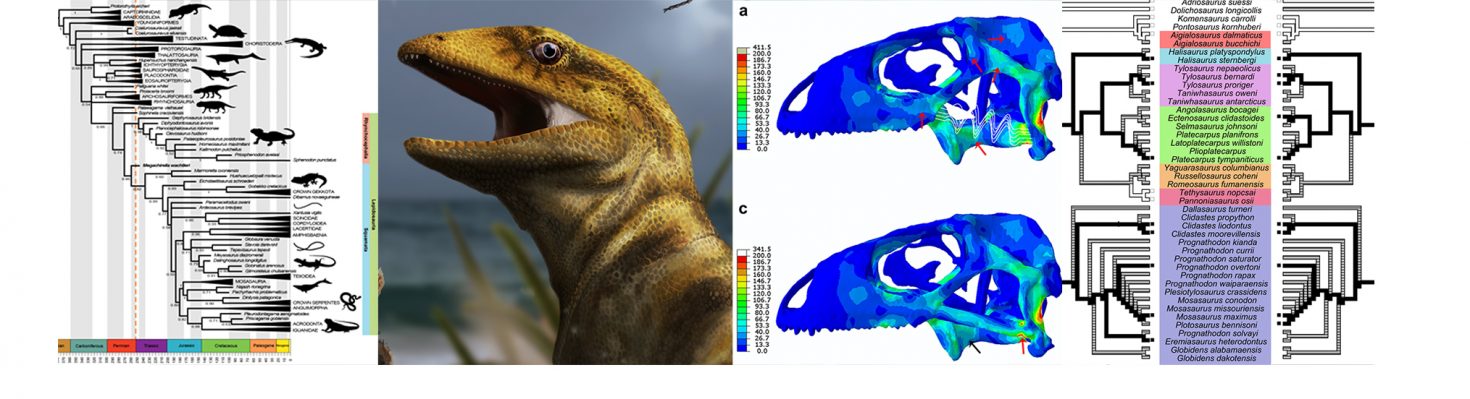
I develop and apply new methods in phylogenetic and macroevolutionary inference to understand the drivers of phenotypic and genomic diversity in reptiles, as well as the major drivers of phenotypic radiation and diversification across vertebrates. Check here more details in the lab’s research program.
Historical background
I started my career in my home city (Rio de Janeiro, Brazil), where I obtained my BSc and MSc in Biological Sciences-Zoology at the Federal University of Rio de Janeiro and the National Museum of Brazil. I moved to Canada to pursue my PhD at the University of Alberta to shed light on the century-old problem of the origin of squamates (lizards and snakes) using new phylogenetic tools and combining morphological and molecular data. In 2018, the key paper stemming from my PhD thesis, where we bridged the gap between molecular and morphological hypotheses of early squamate evolution, was featured on the cover of the journal Nature. In 2018, I was awarded the first Alexander Agassiz Fellowship from the OEB/MCZ at Harvard University, followed by an NSERC (Canada) Fellowship, to expand my research to a broader set of questions in vertebrate phylogenetics and macroevolution evolution. In 2024 I joined the Dpt. Ecology and Evolutionary Biology, Princeton University as an Assistant Professor. I am also a Research Associate in the Division of Vertebrate Zoology at the American Museum of Natural History, and Associated Faculty at the High Meadows Environmental Institute and the Brazil LAB-Princeton Institute for International and Regional Studies (PIIRS), both at Princeton University
Current lab members:
Postdocs:
Dylan DeBaun
I am a postdoctoral researcher studying the genomic basis of complex traits in lizards and snakes. My work combines comparative genomics, morphometrics, and evolutionary biology to address how key innovations repeatedly evolve in highly diverse groups. I develop novel machine learning models to answer these questions. I received a BSc from the University of Michigan and a PhD from the American Museum of Natural History.

Heather Skeen (EEB Fellow)
I am a postdoctoral researcher testing the migratory escape hypothesis in birds. I received my PhD at the University of Chicago, after which I spent two years at University of Connecticut as a Research and Teaching Scholar. My research explores the ecological and evolutionary processes shaping host-microbiota interactions in birds, with a particular emphasis on utilizing museum specimens as a key resource.
Luisa Pusch
I started my career in my home country (Germany), were I obtained my BSc in Biology at the University of Greifwald and my MSc in Organismic Biology and Evolution at the Humboldt-University of Berlin. My doctoral degree I also obtained at the Humboldt University of Berlin were I worked on the origin of Cynodontia, the synapsid group ancestral to and including mammals, in the Jörg Fröbisch lab at the Museum für Naturkunde Berlin under the supervision of Prof. Jörg Fröbisch and Dr. Christian Kammerer. My research interests centre particularly on the systematics and evolutionary history of non-mammalian synapsids, the dominant group of land vertebrates at the end of the Paleozoic, and mammals. I am also working on the evolution of the nervous and sensory system in these lineages using modern computed tomography.

PhD students:
Juan Daniel Vásquez-Restrepo
I am a Colombian biologist interested in studying macroecological and macroevolutionary patterns of species diversity across broad spatial, temporal, and phylogenetic scales. I am also actively working on the taxonomy and systematics of Neotropical reptiles, with a particular emphasis on snakes and gymnophthalmid lizards. Additionally, I am a self-taught nature photographer and programmer.

Izabel Salvi
I am a PhD candidate at EEB – Princeton with a background in biology. My main scientific interests can be reduced to the simple question of what drives diversification and morphological disparity. For my doctoral research, I will be integrating genetic and morphological data, employing both empirical and theoretical approaches, to deepen our understanding of macroevolutionary patterns in Squamata.

Ruthvik S. Pallagatti
I am broadly interested in evolutionary patterns and their underlying mechanistic processes. I am currently a first-year graduate student at the Simões lab, where I’ll be working on phylogenetic inferences using clock models in macroevolutionary research. Before joining Princeton EEB, I was a MEME student (Erasmus Mundus Masters in Evolutionary Biology), and my research experience has been quite diverse, from working with agent-based models of host-parasite coevolution and phylogenetics-based trait evolution to studying sleep in a highly social bird in the wild. Outside academia, one can find me either bouldering or in some water body.
Undergraduate students:
Lilia J. Burtonpatel (EEB/Mechanical and Aerospace Engineering)
Carter Lang (EEB)
Past students and lab members
Postdocs:
Nicolás Mongiardino Koch (University of Colorado, Assistant Professor)
PhD students:
MSc students:
Previous institutions
Robert Noble (Harvard Extension School, Cambridge, USA). 2021-2022.
Thesis topic: Evolutionary biomechanics of the lepidosaur lower jaw. Currently in progress.
Advisor: Stephanie Pierce/ Co-advisor: Tiago R. Simões
Maria-Luisa Chavarría (Universidad Nacional Autónoma de México). 2015-2017:
Thesis: “New data on the Late Cretaceous lizard Dicothodon bajaensis (Squamata, Borioteiioidea) from Baja California, Mexico reveals an unusual tooth replacement pattern in squamates”.
Supervisor: Marisol Montellano-Ballesteros / Co-advisor: Tiago R. Simões

